Incremental Paradox: When “Just One More Document” Breaks Event Safety

Incremental Paradox: When “Just One More Document” Breaks Event Safety
Leaders rarely set out to create complexity. In fact, most complexity is born from good intentions. A small fix here. An extra safeguard there. A sensible addition made in response to a sensible concern.
Over time, however, those well-intentioned decisions collide with reality. What emerges is what strategy thinkers describe as the Incremental Paradox: a situation where a series of rational, incremental improvements quietly transforms a system into something fragile, bloated, and ultimately unfit for purpose.
This paradox sits at the heart of how safety documentation has evolved in many organisations.
The Incremental Paradox, Explained
The concept is explored in the work of Anti-Complex Rend Stephan, which examines how complexity creeps in not through bad decisions, but through too many locally rational ones.
Incremental change feels safe because it follows a simple pattern:
“I see a problem. I address the problem.”
Each response is justified. Each change feels responsible. But when viewed as a whole, the system becomes dense, disjointed, and difficult to reason about.
Two illustrations from the book make this painfully clear.
Illustration One: The Expanding House

Imagine a couple buying their first home.
At first, the house fits their needs perfectly. Then life changes. A child arrives. Then another. A home office is needed. A larger kitchen. A conservatory. A loft conversion. A utility room.
Each extension makes sense at the time.
But step back after ten years and the house is no longer coherent. Flow is awkward. Heating is inefficient. Wiring is patchy. Some rooms barely get used. Others are overloaded. What started as a tidy, well-designed structure has become a maze of compromises.
No single decision was wrong. The accumulated effect was.
Illustration Two: Boeing and Incremental Engineering
A more sobering example comes from aviation.
For decades, Boeing successfully evolved the same aircraft platform rather than starting again. Engines changed. Systems were adapted. Software compensated for hardware constraints. Each iteration preserved familiarity and avoided the cost of a full redesign.

Until it didn’t.
The tragic failures of the Boeing 737 MAX exposed the dark side of incrementalism. Layers of compensating fixes masked growing structural complexity. Engineers were managing symptoms, not redesigning the system from first principles.
Incremental change delayed the hard decision. The cost of that delay was catastrophic.
How the Incremental Paradox Shows Up in Safety Documentation
Now bring this thinking into the world of event safety.
Most safety document suites begin life clean and manageable:
A core risk assessment
An emergency plan
A few supporting appendices
Then reality intervenes.
A new regulation appears.
A venue asks for “just one more document.”
An insurer raises a query.
A consultant adds a section “to be safe.”
An incident prompts another appendix.
And crucially:
No one wants to delete anything.
Because deletion carries risk. If something is removed and later questioned, responsibility follows. So documents only ever grow.
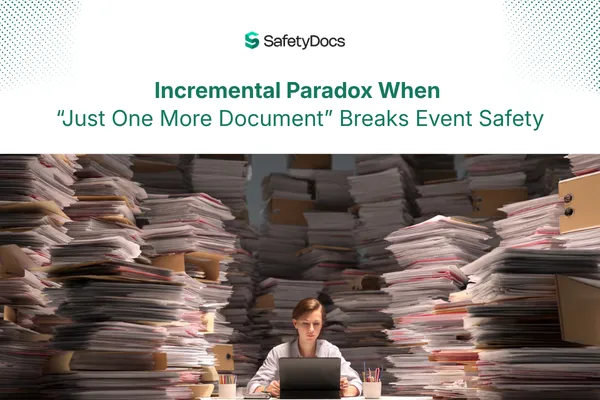
What you end up with is not a safety system, but a safety archive:
Dozens of PDFs
Hundreds of pages
Repeated content
Conflicting versions
Out-of-date contact details
Critical information buried in appendices
On site, under pressure, these documents are effectively unusable. The people who need the information most cannot find it quickly enough to act.
The Incremental Paradox has done its work.
The Four Failure Modes of Incremental Safety Docs
Over time, incremental documentation leads to predictable organisational failures:
Stagnation
The document set becomes so heavy that meaningful improvement stops. Everyone senses that starting fresh would be better, but the perceived risk is too high.
Inflexibility
Static PDFs cannot adapt to live events, changing conditions, or role-specific needs. Information is locked in place while reality moves on.
Loss of Vision
Safety becomes about document completeness rather than operational clarity. The original purpose, keeping people safe, is obscured by paperwork.
Decreased Motivation
Teams disengage. They update documents because they have to, not because they believe they help. Safety becomes compliance theatre.
This is complexity compounding itself.
Why Incrementalism Persists
Leaders often default to incremental change because it feels responsible. Faced with the choice to improve an existing system or re-architect it entirely, improvement feels safer.
This is the trap.
First-principles thinking is postponed again and again, long after the system has passed its useful life.
The Way Out: From Documents to Systems
The answer is not “fewer safety controls.” It is better structure.
A modern safety system must:
Hold a single source of truth
Eliminate duplication by design
Allow information to be updated once and reflected everywhere
Surface the right information to the right people at the right time
Be usable live, on site, under pressure
This requires moving away from static files and toward a streamlined, online safety platform.
From Incremental Fixes to Intentional Design
Instead of endlessly extending the house, you redesign it.
Instead of compensating for legacy systems, you rethink the architecture.
Instead of adding “just one more document,” you ask a better question:
What does someone actually need to know, right now, to keep people safe?
Platforms like SafetyDocs are built around this principle. They replace sprawling document libraries with structured, role-based, live safety systems. Content is modular. Updates propagate instantly. Responsibility is clearer, not riskier.
Most importantly, safety information becomes usable again.
Final Thought
The Incremental Paradox teaches a hard lesson: complexity is rarely a sudden failure. It is a slow accumulation of reasonable decisions that nobody ever steps back to question.
If your safety documentation feels heavy, fragmented, or overwhelming, that is not a failure of effort. It is a signal.
Sometimes the safest move is not the next small fix, but the decision to start again, deliberately, with clarity.
safetydocs.org