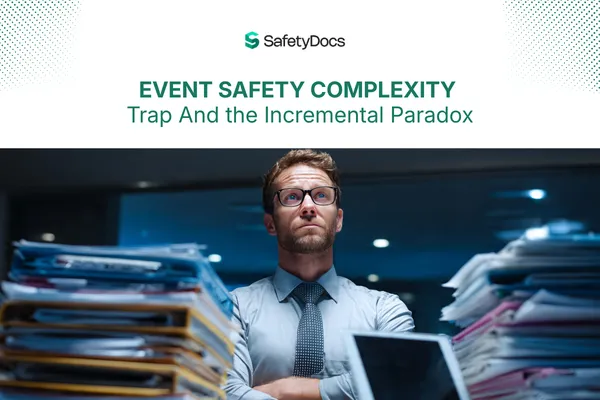
Event Safety Complexity Trap and the Incremental Paradox
Modern events operate in fast-moving, high-risk environments. Regulations evolve regularly, public expectations increase, and scrutiny intensifies after every incident. As a result, Event Safety Management has become more complex than ever before.
Many organisations respond by adding more documents, more procedures, and more controls. However, this approach often leads directly into the Event Safety Complexity Trap. Instead of improving performance, complexity slows decisions and weakens real-world response.
This article explores how complexity develops, why the Incremental Paradox makes it dangerous, and how Safety Infrastructure offers a more resilient path forward.
1. The Blinding Fog: Understanding the Complex Disease
The Matrix is everywhere. It is the world that has been pulled over your eyes to hide the truth: that you have been born into a prison you cannot smell, taste, or touch—a prison for your mind. In the high-stakes theatre of modern leadership, this prison is constructed from the "Complexity Mindset." It is a self-inflicted epidemic that drains vital energy and results in constant motion with little forward movement.
Complexity is not a necessity; it is a parasite. As a Senior Strategist, I have seen this Complexity Disease eat away at the potential of the most brilliant leaders, leaving them trapped in a "Complexity Trap" of their own making. This disease acts as a blinding fog that prevents proper performance through three primary mechanisms:
Clouded Vision: Leaders lose the ability to see the underlying signature or essence of the problems they are paid to solve.
Distorted Judgment: Form begins to take precedence over substance. Eloquence is mistaken for truth, and a 500-page report is mistaken for a solution.
Hindered Action: Organisations become paralysed by "analysis paralysis," requesting more data to feed a monster that can never be satiated, while actual performance flatlines.
To solve any performance crisis, we must first look inward. We must confront the complexity we have manufactured ourselves before we can hope to impact the world outside.
2. The Three Stages of Sophistication
Sophistication is the great force of human advancement, but it is a flow that most leaders fail to complete. It is a journey through three distinct stages, and the middle ground is where the most dangerous traps are set.
The Sophistication Journey
Most organizations reach the Positive Complexity Zone, where adding sophistication leads to higher performance. Because this growth feels exhilarating, leaders mistakenly believe they should stay there forever. They believe they can "manage" more and more complexity, unaware that they are approaching the cliff of the Complexity Trap where complexity stops being a friend and becomes a terminal disease.
At this stage, many safety systems appear mature. However, this is often where Event Safety Management begins to weaken. Complexity grows quietly while leaders remain confident in documentation rather than outcomes.
The Incremental Paradox: "The Home Renovation Syndrome"
The most rational decisions often lead to the most irrational outcomes. This is the Incremental Paradox, or what I call the "Home Renovation Syndrome."
Imagine a family in an old house. They add a bedroom for a new child. They renovate the kitchen. They add a garage. Each decision is logical, rational, and warranted. However, eventually, they find themselves with a sprawling, high-maintenance, inefficient mess. They have a "renovated" house that costs more to maintain and performs worse than a "clean-slate" modern home. They are trapped by "continuous improvement."
In professional systems, "continuous improvement" becomes a vicious cycle of non-performance for three reasons:
Stealthy Creep: Complexity enters the DNA of the system bit by bit. Because the changes are small, they go unnoticed until the system is unmanageable.
Legacy Constraints: New solutions are forced to work around outdated foundations, creating "patches" rather than progress.
The Law of Diminishing Returns: Eventually, the energy required to maintain the complex system exceeds the value gained from it, leading to a sudden, unforeseen collapse.
This paradox explains why many event safety plans fail under pressure. Although each update feels sensible, the accumulated effect pushes organisations deeper into the Event Safety Complexity Trap.
Case Study I: The Boeing 737 MAX and the "Workhorse" Failure
The tragedy of the Boeing 737 MAX is a textbook illustration of the Incremental Paradox. The 737 was a 1960s "workhorse." When faced with the need for a more efficient aircraft to compete with Airbus, Boeing chose incremental updates over the "Clean-Slate" design they had initially discussed.
Anatomy of a Trap
The Legacy Constraint: The original 737 design sat very low to the ground.
The Incremental Solution: To fit newer, larger, more efficient engines, engineers placed them higher and further forward on the wings so they wouldn't touch the ground.
The Resulting Complexity: This changed the aircraft’s aerodynamics, making the nose pitch up dangerously during certain manoeuvres.
The Complex Patch: To "fix" this instability, engineers added the MCAS software layer to automatically push the nose down.
The "So What?" Insight: This is the Blind Illusion in action. Boeing’s leaders and engineers believed that a complex system could be perfectly modelled and predicted. But complex systems are not modellable. When the real world hit, the MCAS failed to behave as the models predicted. By trying to "squeeze performance" from an old design through incremental complexity rather than a redesign, the system became fragile. Tragic non-performance, the loss of 346 lives, was the ultimate cost of failing to escape the Complexity Trap.
5. Case Study II: The Static Document Trap in Event Safety
The same paradox infects information systems. In event safety, we see what Rend calls the "Explosive Mix": a volatile combination of Ambiguity, Dark Side Experts, and Surrendering Leaders.
Ambiguity: Safety regulations and emerging laws, like Martyn’s Law, are inherently ambiguous.
Dark Side Experts: Consultants thrive on this ambiguity, producing 500-page "static" PDFs that prioritise form and eloquence over operational truth.
Surrendering Leaders: Venue managers surrender their authority to these experts, merely hitting "save as" on outdated templates to create a false sense of compliance.
Traditional Document Handling vs. The Reality of Live Operations
The "Contractor Management Bottleneck" is a classic example of endogenous complexity, complexity created internally through outdated tools.
6. The Remedy: Crossing the Simplicity Gateway
To break free, you must take the "Red Pill." You must wake up to the reality that complexity is your primary enemy. Crossing the Simplicity Gateway is not about "simplification," which is often a Simplistic Relapse. True Simplicity is an advance. It is the "Ultimate Sophistication."
The Complexity Warrior’s Toolset
• Reframe: Question the fundamental diagnosis of the problem rather than treating surface symptoms.
• Redefine: Focus on a single, clear purpose that resolves the core issue without adding unnecessary features.
• Redesign: Take a clean-slate approach, discarding legacy constraints in favour of a simple architecture.
7. The Anti-Complex Model: SafetyDocs as Infrastructure
A true Complexity Warrior does not patch documents. They redesign systems. SafetyDocs represents Ultimate Sophistication by moving venues from complexity to clarity. It is not a document library. It is Safety Infrastructure.
SafetyDocs replaces flat documents with structured components. When information changes, updates apply everywhere instantly. Role-based access removes noise and sharpens judgement. Live updates ensure operational sync during events.
By moving from managing PDFs to Safety Infrastructure, venue managers reduce friction and protect performance during live operations.
8. Conclusion: Becoming a Complexity Warrior
Complexity is the main driver of non-performance and the primary threat to leadership. To achieve resilience, leaders must recognise complexity as a self-created problem.
Awareness allows improvement to begin. Insight comes from focusing on what truly matters. Impact requires courage to reject unnecessary exceptions. When leaders redesign systems instead of patching them, Event Safety Management becomes stronger.
Escaping the Event Safety Complexity Trap is not easy. However, those who understand the Incremental Paradox and invest in Safety Infrastructure protect people, operations, and trust.