Light, Colour, Evacuations
What a new Dutch study tells stewards about how crowds actually choose their route, and what most venues have never assessed.
A study landed this month from Delft University, Duives and van Beek, published in Transportation Research Record. They put 64 people in a VR maze and varied the lighting at every T-junction. Red corridors. Green corridors. Bright, dim, very dark. They watched which way each person turned.
It is the kind of paper most stewards will never read.
The operational implications land squarely in their lap anyway.
What the study found
The headlines are simple.
People avoid red corridors. People avoid dark corridors. They walk toward green and, to a lesser degree, blue.
Green pulls hardest. In the most extreme combination, red on the left and green on the right, around 99.7% of participants chose the green side.
The reason is cultural, not biological. Red and green carry meaning we have all been trained on since childhood. Traffic lights, exit signs, emergency drills. The study is Dutch, but the British conditioning is identical. Green is go. Red is stop.
Three findings sit underneath the headline.
One. Not everyone responds the same way. The researchers identified three distinct segments in the population. Light-sensitive people avoid red and dark and chase green. Darkness-avoiding people swerve away from very dark corridors but are less influenced by colour. Then there is a third group, roughly a quarter of the sample, who will turn right whatever you put in front of them.
Two. Light nudges only steer a portion of the crowd. They shift probability, not certainty.
Three. The pull works hardest when the preferred corridor is on the right. The colour cue stacks with the right-hand bias most people already carry.
Why this matters at 4pm on show day
A steward standing at a fork during an evacuation is the person actually closing the gap between what the venue thinks will happen and what does happen. The study is describing exactly the choice they are managing in real time.
A few things follow from it.
The colour of the kit and equipment around the route is part of the cue. Yellow hi-vis reads as neutral. A red barrier, a red painted door, a red-filtered torch are all sending a stop signal to most of the crowd. If the route you want people to take has a red surround, you are fighting your own nudge.
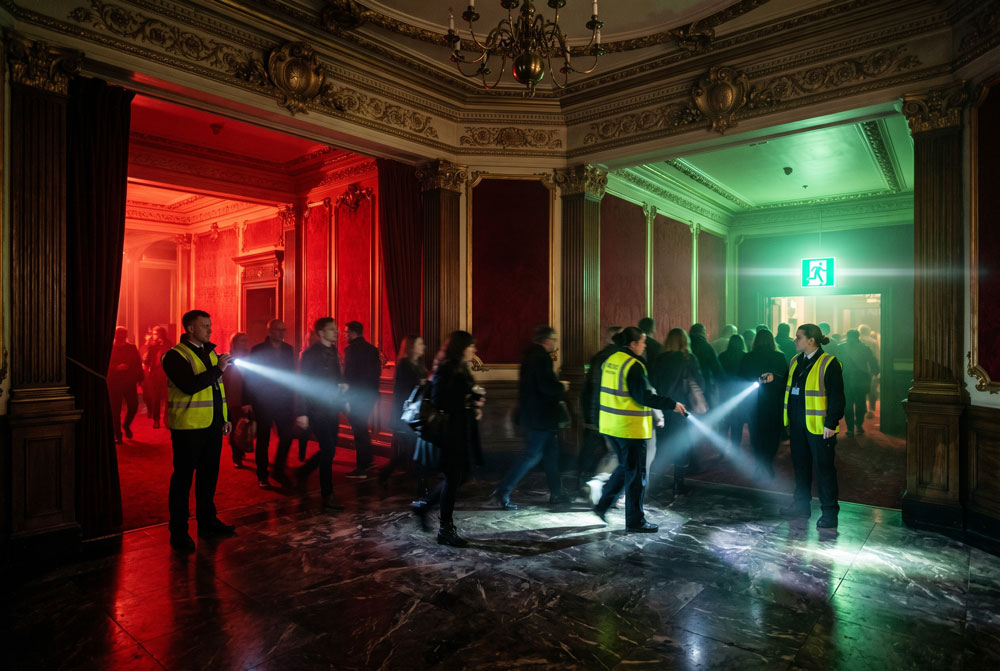
Phone torches matter. Most stewards default to their phone torch when something goes wrong. That is a broad, uncontrolled white light. It does not tell anyone where to go. A torch deliberately pointed at the floor of the preferred route is a directional cue. A torch swept across faces is not. It is worth asking whether your stewarding team actually carries proper torches, or whether you have quietly outsourced that to whoever remembered to charge their phone.
Roughly a quarter of the crowd will go right whether you want them to or not. That is a measurable segment of the population, not a hypothesis. If your designated route is on the left, signage on its own will be ignored by the right-bias group. You need an active steward at that junction redirecting the drift.
The light-sensitive segment responds strongly to the contrast between "dark and red" and "lit and green". If your secondary route is dimly lit and runs past a red feature wall, it is functionally invisible to those people.
The pre-shift briefing question
Most pre-shift briefings cover the running order, the layout, the comms plan.
How many cover the colour of the route?
It is a thirty-second addition. Walk the team to the junction. Point at the cues the audience will see. Tell them which way you want the flow to go, and name the steward who owns redirecting the right-hand drift. Tell them where to point a torch, and where not to.
That is not a training course. It is a briefing line.
The older-venue problem
Now apply this to a Victorian theatre. A listed hotel ballroom. A stately home converted for weddings.
Older venues were not built with signage in mind. They were built with decor in mind. Deep reds, gilt, warm amber lighting, heavy curtains drawn across what are technically exits, recessed alcoves that read as dark dead-ends, chandeliers that compete with the green of the running-man sign for attention.
Every one of those choices is now a nudge.
A green emergency exit sign mounted above a red velvet curtain is not the clean cue the regulations imagined. A corridor lit by warm amber wall sconces is reading as "not the brighter route". A decorative red carpet at the head of the wrong staircase is silently telling a quarter of your crowd to stop.
The question for the operator is whether anyone has ever assessed the venue with this lens. Not the fire officer signing off the lit exit signs in test mode. An actual walk, in the lighting state the venue is in during an event, asking which routes the decor is selling and which routes the decor is hiding.
Most venues have not done that walk.
Where this sits next to Martyn's Law
The Terrorism (Protection of Premises) Act sets the expectation that venues in the enhanced tier will have formal security assessments and documented procedures by April 2027. Those documents will cover routes, capacities, signage, training.
Almost none of them will cover whether the decor is fighting the signage.
That is not a gap a SAG meeting tends to surface. It is the kind of thing a walk-through with a stewarding lead and a lighting designer would surface in twenty minutes. And it is the kind of finding that has to land in the head of the steward at the door, not in a PDF on a shelf.
A question for venue ops
If your evacuation route runs past a red feature wall, an amber-lit corridor, or a decorative dead-end, has anyone walked it with this in mind?
And does the steward on the door know which way the room is silently pointing the crowd?
Reference: Duives, D. C., & van Beek, A. H. N. (2026). Does Light Influence Route-Choice Behavior? Discrete-Choice Modeling Study. Transportation Research Record. https://journals.sagepub.com/doi/10.1177/03611981261438029
David Franklin is the founder of SafetyDocs, a real-time compliance platform for event safety documentation.